
Goal execution
How to Follow Through on Goals: Build an Execution Loop
Follow through on goals with a practical loop that turns one outcome into a rolling two-week plan, daily check-ins, and explicit replanning decisions.
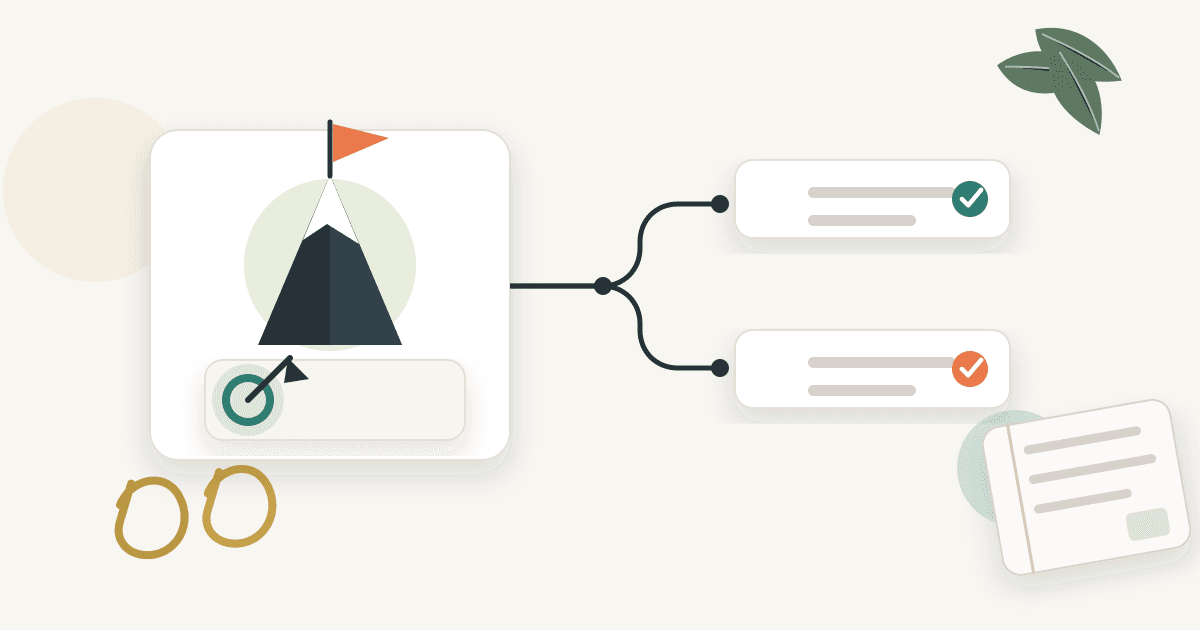
Following through on goals is not the same problem as setting them. A deadline and a measurable outcome can clarify where you want to go, but they do not tell you what to do on an ordinary Wednesday after the original excitement has faded.
The missing piece is usually an execution loop: a repeatable path from the goal to a near-term plan, from the plan to today's action, and from actual results back to a decision.
We arrived at this model while building Aimo. Early planning flows could produce an impressive long-range task list in one conversation. The output looked complete, but that was the problem: it treated guesses about month four as if they were as reliable as actions for next Tuesday. We changed the product around a shorter, rolling planning window instead.
This article explains that model. It is also a framework you can run with a document, calendar, or notebook without using Aimo.
The goal is direction, not today's instruction
Consider this goal:
Launch a paid beta for my side project by November 30.
It is specific enough to evaluate. It is still not executable. “Work on the beta” could mean interviewing users, fixing onboarding, writing pricing copy, or polishing a dashboard nobody has tested.
An executable system needs at least four layers:
| Layer | Question | Example |
|---|---|---|
| Goal | What outcome matters? | Launch a paid beta by November 30 |
| Near-term progress | What must become true soon? | Five target users complete onboarding |
| Next action | What can I do at a specific time? | Tuesday: send seven test invitations |
| Evidence | What actually happened? | Four sent, two replies, one onboarding failure |
Most goal systems spend a lot of time on the first row. Follow-through happens in the other three.
Use a rolling two-week plan
Planning the entire goal at task-level detail creates false precision. Planning only today makes it easy to lose the larger thread.
We use a rolling two-week window as a middle ground:
- Week 1 contains commitments with dates and completion conditions.
- Week 2 is a lighter preview based on what Week 1 is expected to reveal.
- At the review point, evidence replaces assumptions and the window rolls forward.
For the paid-beta goal, the plan might look like this:
Week 1 outcome
Five target users receive an invitation and the onboarding path is observed.

Tuesday
Send seven invitations.
Done when: seven messages are sent to people matching the target profile.

Thursday
Watch two onboarding attempts.
Done when: friction points and exact drop-off steps are recorded.

Week 2 preview
Fix the largest verified onboarding blocker and repeat the test.
Notice what is missing: a detailed November launch checklist. The plan goes only as far as current evidence can support.
You can copy the complete goal-based weekly planning template for this step.
Give every action a date and a finish line
“Improve onboarding” is a topic. It is not a task.
A next action should answer two questions:
When will I do it?
What observable condition means it is done?
Compare these versions:
| Vague | Executable |
|---|---|
| Research competitors | Wednesday: record the onboarding steps of three products |
| Write landing page | Friday: draft the hero and one CTA for a single audience |
| Exercise more | Tuesday at 7 PM: walk 30 minutes and log the session |
This resembles an implementation intention: connecting a situation to a concrete action. Research on implementation intentions has repeatedly found that specifying when and how an action will happen helps close the gap between intention and behavior. The Princeton goal and motivation guide gives a useful overview.
Make the system come back to you
A plan can be perfectly structured and still disappear.
This is the product decision behind Aimo's push-first design. Most personal planning tools wait for the user to open them. That is fine while the routine is healthy. It becomes fragile precisely when work slips and opening the task list feels unpleasant.
Aimo currently uses Discord DMs for this reason. It brings the day's actions into a channel the user already checks, then records a short completion or missed-task response. The dashboard is a secondary view, not the trigger for the loop.
You can reproduce the same principle without software:
- put the next action on a calendar rather than leaving it in a project page;
- ask an accountability partner to request a binary update;
- schedule a message to yourself with the exact task and finish line;
- keep the check-in answer short enough that you will still send it on a bad day.
The important property is not the notification. It is that the goal returns with context: what is due, why it matters, and what happened last time.
Treat missed work as evidence
A missed task should change the plan, not merely become overdue.
When an action slips, classify the cause before moving it:
| Signal | Likely planning problem | Adjustment |
|---|---|---|
| The task was never started | Start condition was vague | Add a time, place, and smaller first step |
| It repeatedly took longer | Estimate or scope was wrong | Reduce the deliverable |
| Urgent work displaced it | Capacity was already committed | Remove another commitment or extend the date |
| It was completed but created no progress | Task was weakly connected to the goal | Replace the task, not the goal |
| The goal keeps losing every trade-off | Priority may have changed | Run a goal review |
This is where a simple todo list often stops and goal management begins. Carrying every overdue item forward preserves the old assumption. Replanning uses the new evidence.
End the loop with a decision
At the end of the window, do not ask only, “What should I do next?” Ask what should happen to the goal and plan.
The decision set we use in Aimo is intentionally explicit:
- Keep: the goal and scope still fit; draft the next window.
- Change: the desired outcome has changed.
- Reduce: the goal matters, but the scope is too large.
- Extend: the goal matters, but the date no longer fits.
- Stop: continuing is no longer the right trade-off.
Aimo can surface a review when the recorded pace falls behind, but it does not silently rewrite the goal. The person pursuing the goal approves the decision. That boundary matters: planning can be automated; commitment cannot be delegated.
Use the goal review checklist when the issue is larger than next week's task list.
The complete goal execution loop
The loop is small enough to run every week:
1. State one outcome and deadline.
2. Define the next two weeks of progress.
3. Give Week 1 actions dates and finish lines.
4. Bring today's action back into view.
5. Record completed and missed work.
6. Keep, change, reduce, extend, or stop.
7. Roll the window forward using the evidence.
This is not a promise that every goal will succeed. It is a way to stop a goal from failing silently. You can see the plan, observe reality, and make the next decision before another month disappears.