
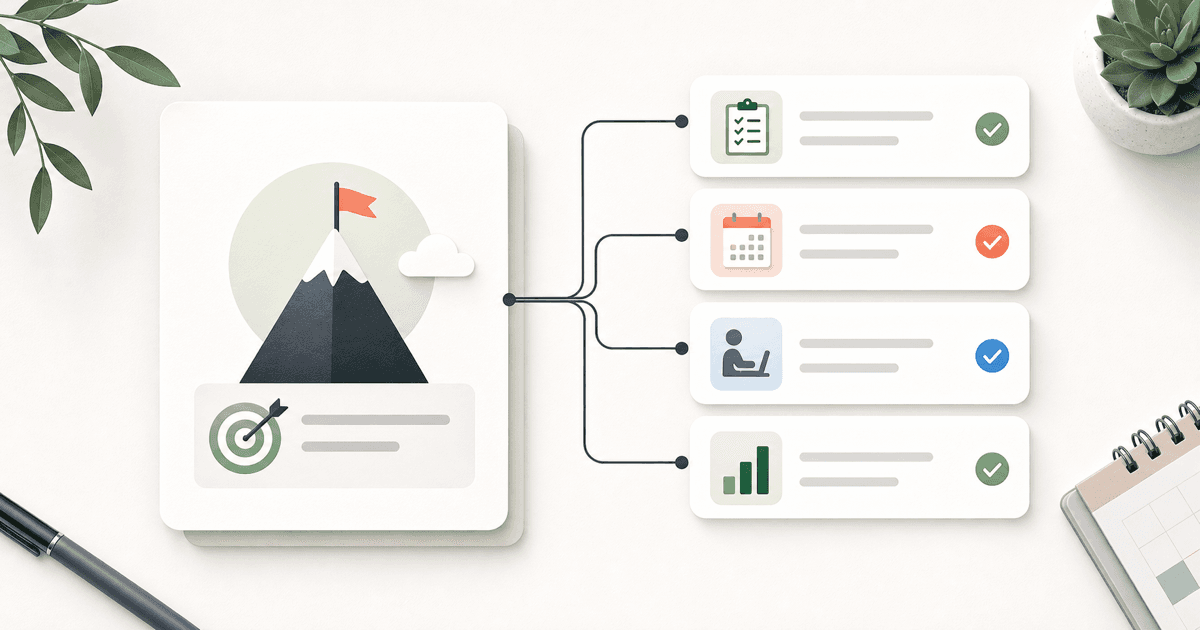
You can have a clear goal and still not know what to do tonight.
Launch a side project sounds clear when you write it down. You know the project matters. You want to make it real. But when you sit down after dinner, the goal opens into too many choices.
Should you write code, fix the landing page, talk to users, choose a name, set up analytics, or sketch the onboarding flow?
The problem is not that the goal is missing. The problem is that the goal has not been lowered into the next visible action.
A goal is direction, not a task
Big goals are useful because they give direction.
Launch a side project.
Work out consistently.
Publish every week.
Improve my English.
Prepare for a career change.
But none of these are good tasks.
They still contain too many decisions. Publish every week could mean choosing a topic, researching, outlining, drafting, editing, publishing, or reviewing what happened after the post goes live.
A good task removes some of those decisions. It says what to do next, when it belongs, and what done looks like.
A specific goal can still be hard to act on
Specific goals are usually better than vague ones. Launch a side project within three months is more useful than build something someday.
But even that goal does not tell you what to do at 8 p.m. on Tuesday.
To make a goal executable, you need two layers between the goal and today's work:
Goal
-> this week's progress
-> next visible action
Without those layers, the goal stays clear in your head but blurry in your day.
Use three questions
You do not need a complex project-management hierarchy to start.
Use three questions:
1. What progress would matter this week?
2. What next action would create that progress?
3. Which date should that action happen on?
For example:
Goal:
Launch a side project.

This week's progress:
Decide whose problem the project is solving.

Next action:
List five possible user problems.

Dated task:
Tuesday: list five possible user problems.
Now the goal is not floating somewhere in the future. It has entered this week.
This is the same pattern behind a good weekly planning template: choose progress first, then choose the actions.
Give the action a date and a finish line
Tasks slip when they are too large, undated, or hard to verify.
Weak task:
Prepare the side project.
Better task:
Tuesday: list five possible user problems.
The second version works better because it answers two questions:
When does this belong?
What will be true when it is done?
The same applies to writing.
Weak task:
Write the blog post.
Better task:
Wednesday: write five section headings.
If it helps, you can add a time and place. That is close to the idea of an implementation intention: when a specific situation happens, you do a specific behavior.
When I sit at my desk on Tuesday at 8 p.m.,
I will list five possible user problems.
But the basic version is enough for many goals: a date and a finish line.
Make the next action small enough to start
Small does not mean unimportant. Small means startable.
A good next action usually has three traits:
- you can attempt it in 30-60 minutes
- you can see whether it is done
- it creates information or visible progress
For work out consistently, useful actions might be:
Monday: walk for 20 minutes.
Tuesday: choose two workout days for this week.
Wednesday: compare three nearby gyms.
For improve my English:
Tuesday: read one article.
Save five unfamiliar phrases.
Thursday: read the five saved phrases out loud.
For publish every week, the next action should connect to why the post matters this week:
This week's progress:
Publish one post that supports the current product or marketing goal.

Monday:
Choose 3 topics connected to this week's goal.

Tuesday:
Choose 1 search intent and 1 useful takeaway for the reader.

Wednesday:
Write the opening and 1 concrete example.

Friday:
Publish the post and save 1 question to test in a short thread.
These actions are small enough to start, but they still move the larger goal.
Do not put every broken-down task into this week
Breaking down a goal can create a long list. That list is not your weekly plan.
If you have two real hours for the goal this week, choose the smallest meaningful progress that fits inside those two hours.
Ask:
How much time can this goal actually get this week?
What progress would still matter within that time?
What can wait without damaging the goal?
The point of breaking down a goal is not to create more tasks. It is to create a plan that can survive the week you actually have.
If the goal already slipped and you are trying to recover, use how to get back on track with goals before building a normal task plan again.
Goal management means lowering the goal again and again
Breaking down a goal once is not enough.
The week changes. Work runs late. Energy changes. One action takes longer than expected.
So the next plan has to ask:
What actually moved this week?
What got stuck?
Is the next action still right?
Should it be smaller?
Do the dates or task density need to change?
This is why goal execution needs a loop, not just a list. If you want the larger structure, read how to follow through on goals.
How Aimo helps
Aimo is designed for the ordinary part of goal management: bringing the goal back down into this week.
You can declare a goal in Discord. Aimo helps turn it into near-term progress and dated, one-day tasks. If you share your available weekdays or daily time budget, the plan can stay closer to the week you actually have.
Then completed and missed work stay attached to the goal. The next plan does not have to start from memory or mood.
Aimo does not do the goal for you. It helps keep the goal from staying as a vague sentence in your notes.
Summary
Breaking a goal into actionable tasks is not about making a longer list.
Use this sequence:
- define the progress that would matter this week
- choose one next action that creates that progress
- give the action a date
- make completion visible
- keep only the tasks that fit the week you actually have
If a goal still feels vague, you may not need a bigger plan. You may need a smaller next action.
References: